

Ships and shipping brought glamour, excitement and opportunity to port cities, but experiences of travelling and emigration did not always live up to expectations.
I have been thinking a lot about the experiences of emigration recently, partly because of the release of my new co-authored book on child emigration from the North-West of England to Canada, https://www.mqup.ca/friendless-or-forsaken–products-9780228021278.php I am interested in how working-class memoirists have narrated the experience of leaving a familiar place and arriving at a new one, particularly travelling by sea. Yet I am also struck by how the experience of growing up in a port town or city was very influential for working-class memoirists and it had an important impact on how they saw the world around them and shaped their own approach to travel, movement, and opportunity. Ports brought the global to these towns and cities, ensuring that despite the poverty many inhabitants experiences, they were exposed to a broad range of cultures, ideas and material objects and broad a sense of transience and change.

Harland And Wolff Shipyard, Belfast 1911. In the distance the bow of the Titanic can be seen , 4000 men were engaged in building the ill-fated ship. Image via Getty images.
For children who grew up in port cities such as Liverpool and Belfast, they depicted a confidence and a knowledge of ships, seamen and ports. Robert Harbinson’s accounts of his youth in early and mid-twentieth century Belfast recalled his fist job as a teenager working as a message boy for the ships, explaining that ‘our sort lived and died because of boats.’ His evocative description provides a sense of the buzz, noise, and movement of the docks: ‘The incessant chatter of automatic hammers echoed in their bowels, and sparks flew out where the riveters worked in the dim, smoky recesses. Trails of cloud flung up from the sea into a ragged sky, the cry of twisted metal, and the sight of men sweating in the cavernous holds, sent a shudder through me.’[i] Docks were not just sources of employment for local populations. Ships and docks were a great source of local pride and inhabitants of cities such as Belfast and Liverpool took strong interest in the ships being built, as launches drew huge crowds and were topics of fascination, admiration and delight. When the Titanic launched from Belfast in 1911, for instance, 100,000 spectators turned up to watch the ship leave the city’s Harland and Wolff shipyards.

Titanic Launching, Belfast May 1911, Image via Wikimedia Commons.
Memoirists who grew up in a port towns and cities during the twentieth century evoke this sense of pride and emphasise how it facilitated experiences that felt novel, colourful, and joyful in comparison to the privations and austerity of working-class childhood more generally. Mavis O’Flaherty described the excitement and opportunity afforded by a childhood spent close to Liverpool’s docks: ‘As a child I would stand and watch them unloading ships, and you would see all the bananas, and the dockers used to say “All right girl, come on”… you would go down to the docks and they would give you a big handful of bananas, a big handful, quite a few pounds worth.’[ii] For many children, ships and the docks provided a glimpse into the world beyond their own and were often linked with adventure, rich and luxurious foods and other material items compared to the poverty many experienced at home. We can see how these connotations influenced the recollections of some of those who experienced emigration as children, such as Joe Ayre’s The Socialist, in which he described his emigration to Canada by Louisa Birt’s Sheltering Home in 1923, aged 12. ‘What an adventure this was,’ he recalled, as the ‘passengers were from all parts of Europe, there were Polish people, Germans, Ukrainians, Russians, Bulgarians… They were all poor, the unwanted of Europe going to try their luck in a new land.’[iii] For travellers like Joe Ayre, finally getting the opportunity to travel on one of the ships he had watched so closely in his childhood was a key moment in realising his youthful ambitions for adventure and to seek a new start away from the poverty and squalor he had hitherto experienced.

Umbria steamship in the port of Liverpool, heading to New York City in 1902. Image Via Getty Images
Ports brought the movement of goods and people and, with them, diverse cultures, ideas, and material goods. It made port cities outward looking and global facing, in ways that may seem at odds with the material deprivation and poverty so many of their inhabitants experienced. As Maggie Clark, who grew up in Liverpool’s Scotland Road area in the 1920s and 1930s recalled, ‘We Liverpudlians are outward-looking people, tied to the shifting waters of the river and the churning seas beyond for our livelihoods. Goods came and went. Exotic products, people, sights and smells passed through our neighbourhoods, never staying for long.’[iv] There is also a sense from some memoirists that the kind of control imposed by the state in the Empire was extended throughout the poorer districts of these cities, which were often perceived as crime-ridden, unruly, and difficult to police. The Falls district of Belfast, for instance, was full of references to the world beyond, ‘the narrow streets, whose names Cawnpore and Lucknow alongside Bantry and Tralee, might have been chosen to remind the Catholic population that although it was Ireland it was still part of the British Empire.’[v] Certainly, ports presented distinct challenges for the police as the movement of goods and people attracted thieves, traffickers, and other criminals. Birkenhead policeman Leslie Robinson, was posted to the docks in the late 1950s and, acknowledging that since his own childhood ‘ships and the sea had held a great fascination for me’ but found cargo supervision, which aimed to stop the roaring trade of pilfering from ships, ‘was he most boring job ever dreamed of. This was not a case of cops and robbers but professionals and amateurs – and we were the amateurs!’[vi]
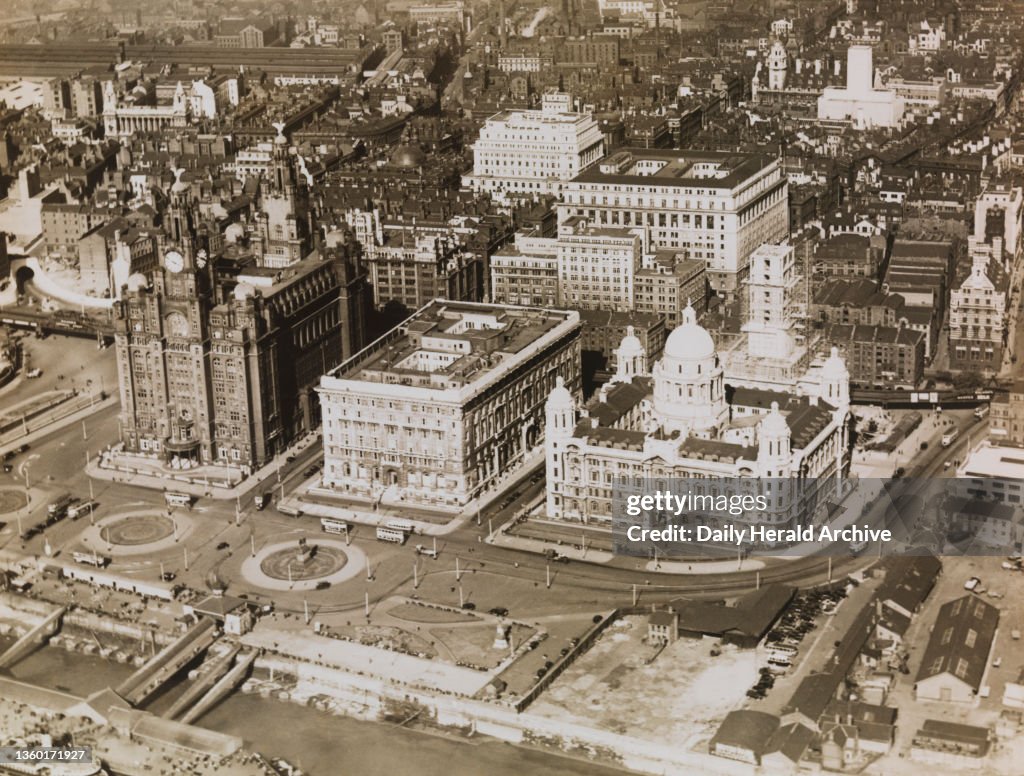
Attempts were made to mirror Manhattan’s skyline to impress those arriving by sea. Image c. 1935, via Getty Images.
Urban planners and local politicians understood the importance of the visual appearance of the skyline of port cities for those arriving by sea. My first book demonstrated how in Liverpool there was an attempt to mirror the New York skyline by investing in impressive architecture that would demonstrate the commercial success of the city and its status as a world-leading port. This approach was picked up by the local Catholic church and the plans to build the second largest cathedral in the world in Liverpool reflected Archbishop Richard Downey’s desire for it to be the first thing seen those arriving by sea, reinforcing the city’s associations with Catholicism. You can access the book here for free: https://www.bloomsburycollections.com/monograph?docid=b-9781474257398
Although the docks represented adventure, luxury goods and adventure for those that had grown up in these port towns and cities and despite the investment urban planners in cities like Liverpool made in the visual impact of the cityscape, those arriving in Britain by boat did not always have a positive impression. Buchi Emecheta’s autobiographical novel, Adah’s Story, narrates the experience of a young Nigerian woman emigrating to Britain in the early 1960s to join her husband. One of the key themes is the shock and horror Adah experienced when she first arrived in the country and recalled her shock when her ship arrived in Liverpool: ‘Liverpool was grey, smoky and looked uninhabited by humans. It reminded Adah of the loco-yard where they told her Pa had once worked as a moulder. In fact the architectural designs were the same.’ Adah, like many migrant women, was travelling with her two young children to join her husband who had already emigrated there who has moved over previously. She felt let down by her husband’s descriptions of Britain and describes the struggle of getting used to the country’s industrial landscape, explaining her shock when she saw the area where Francis had arranged their housing: ‘He did not warn Adah what it was like. The shock of it all nearly drove her crazy…. She could not tell where the house began and where it ended, because it was joined to other houses in the street.’[vii] Helen Tse’s, Sweet Mandarin, describes her grandmother Lily’s experiences of emigration from Hong Kong in the 1950s to Britain, where she eventually settled in Manchester. Lily’s recollections of leaving Hong Kong emphasised the vibrant dockside culture of the port: ‘The dockside was crammed with people: sailors, passengers, well-wishers, and pedlars hawking goods, all jammed together in typical Hong Kong style. People pushed and shoved, chattered and made deals, they bought snacks cooked over makeshift grills set in steel barrels and sold from hastily erected stalls. Hysterical women cried and hugged children while their husbands placed a reassuring arm around their shoulders.’[viii] In comparison, ‘Lily’s first day on English soil was overcast and grey. When she heard the commotion of the docks in Southampton she had raced to the deck to see what England looked like up close, and she was horrified at what she saw… The dishwater skies washed out the nondescript buildings… Southampton had none of the dazzle and hubbub of the great Eastern ports. A flock of seagulls squawked and dived overhead, as if waiting to pick off the weaker passengers. To Lily it seemed to be empty.’[ix]

Victoria Harbour, Hong Kong, 1953. Described as Helen Tse’s grandmother Lily as teeming with excitement and activity as she left for Britain. Image via Getty Images.
These accounts therefore part of a wider disappointment migrants felt when did not live up to the depictions seen in imperial propaganda and through the stories of other migrants. ‘Now she laughs when she tells me how appalled she was – she looks back on Lily then and finds her horror comical – but this first straight of the seat of the Empire was a great disappointment to her.’[x] As has been well-documented, migrants – and particularly Black and Irish migrants, had serious difficulties in obtaining appropriate housing and were often forced to pay extortionate rents for cramped, insanitary and inadequate rooms. In Adah’s Story, her husband Francis had settled in London and had arranged accommodation for them, but it was just a small room with a single bed and sofa inside: ‘She simply stared. She said nothing even when she learned that the toilet was outside, four flights of stairs down, in the yard; nor when she leaned that there was no bath and no kitchen. She swallowed it all, just like a nasty pill.’[xi] The disappointment of arrival and of the drab, lacklustre and desolate skyline migrants like Adah and Lily faced as they reached Britain was therefore representative of the challenges of building new lives and overcoming difficult living conditions that Commonwealth and Imperial citizens experienced in post-Second World War Britain.

Young woman and young girl, in one of the poorest areas of Cardiff in 1954. Black and Irish migrants were subjected to significant racism and discrimination, particularly regarding housing. Image via Getty images.
For others who experienced migration or who travelled by sea, descriptions and memories of food, both positive and negative, crop up in memoirs as a way to convey their feelings about their experiences. Such as Bernadette Robinson, a teacher in Merseyside during the 1960s. Robinson was born in 1944 to Irish parents and she would regularly visit Ireland with her mother and siblings as a child. She recounted how they would smuggle rich food, which was plentiful in Irish farming areas, back to Liverpool, such as one occasion when she was aged about four when hr father collected them from the boat: ‘My dad watched in amazement as we wriggled out of them (coats) to reveal strings of sausages and packs of bacon tied around our waists, adults were searched coming in from Ireland, but children were not.’ For Bernadette, it was a moment that taught her about the value of making the most of the limited resources they had and especially to make the most of her contacts and opportunities associated with their status as second-generation migrants: ‘The whole experience was part of a childhood awareness that the good things of life were in short supply and that it was important to stick up when you could and also “make do and mend”.’[xii]

The experience of immigration could be exciting and difficult, promising and disappointing, and did not always meet expectations. ‘Leaning On Luggage’, Victoria Station, 1956. Image via Getty Images.
Memories of travelling by sea and sausages crop up elsewhere in memoirs. Cherry Simmonds grew up on Merseyside and in the 1970s she, her husband Eric and young son decided to emigrate to New Zealand because of the bleak living conditions they were experiencing. Her memoir, Nobody in Particular, describes the mixed emotions she recalled as they emigrated describing how feelings of hope mixed with fear trepidation at leaving their home. The night before their ship sails from Southampton, Cherry met a family returning to England because they hated NZ: ‘Not like it? That’s a bloody understatement. I feel sorry for anyone contemplating travelling all that way… What a backward bloody place it is. You wait. You want and see.’ His wife explained further: ‘They can’t make sausages like us, you know – and no decent television to watch, it’s all rugby and other foreign stuff. We travelled the length and breadth of New Zealand but we never had a decent sausage the whole of the time we were there.’[xiii] This warning inspired Cherry to hurriedly pack items that she feared she would be unable get in New Zealand, and took a spare suspension for the car; batteries; twelve mop heads; twelve rolls of sellotape; some pan scrubs; Brasso and shoe polish. Here, sausages represented a home comfort that could not be replicated elsewhere, throwing Cherry’s feelings towards emigration into turmoil. Again, we see how this trepidation and fear about leaving Britain was reflected in accounts of the skyline as the boat set sail. Cherry recalled that the departure scene was not like the Hollywood cliches she had seen of glamourous passengers blowing kisses to those ashore: ‘Instead, it was a bleak, overcast, rain-filled day as we peered into the murky water reflecting the lights from Southampton… cold drops of rain stung my face, as my hair stuck to my cold wet cheeks. I felt my flesh grow goose-pimply with the wind on my throat… As the ship moved away from the dock Eric reached for my trembling hand.’[xiv] Whether the port was the first or last thing emigrants saw, their perceptions of the docks, ships and of the city itself was part of a wider description of the experience of emigration itself. Emigration was such a widespread experience for so many across the twentieth century that memoirs provide a fruitful way of understanding the often complex and contradictory feelings of those travelling by sea. It also helps understand why city skylines matter and the ways in which the visual impact of port cities can shape and influence wider experiences and perceptions of travellers, both past and present.
[i] Robert Harbinson, Up Spake the Cabin Boy (The Blackstaff Press: Belfast, 1961), 33.
[ii] J. P. Dudgeon, Our Liverpool: Memories of Life in Disappearing Britain (London 2010), 137.
[iii] BURN/2/29: Burnett Collection of Working Class Autobiographies, Brunel University, Joe Ayre, The Socialist, (1978), 25-6.
[iv] Maggie Clark, Jam Butties and a Pan of Scouse: Hardship and happiness in the Liverpool docks (Trapeze: London, 2016)
[v] John Rae, Sister Genevieve: A courageous woman’s triumph in Northern Ireland (Warner Books: New York, 2001), p. 35-36.
[vi] BURN/2/671: Burnett Collection of Working Class Autobiographies, Brunel University, Leslie J. Robinson, One Step at a Time: The life and Times of “Robbie”, 179.
[vii] Buchi Emecheta, Adah’s Story (Allison & Busby: London, 1983), p.33.
[viii] Helen Tse, Sweet Mandarin (Ebury House: London, 2007), 149.
[ix] Tse, Sweet Mandarin, 163.
[x] Helen Tse, Sweet Mandarin, 163.
[xi] Buchi Emecheta, Adah’s Story (Allison & Busby: London, 1983), p.33.
[xii] Bernadette Robinson, Please, Miss: the true story of a trainee teacher in 1960s Liverpool (Hodder & Stoughton: London, 2012), 8.
[xiii] Cherry Simmonds, Nobody in Particular (Bantam: London, 2000), 279.
[xiv] Cherry Simmonds, Nobody in Particular (Bantam: London, 2000), 281.
 Living on Poverty Street: Working-Class Memoirs and Life-Writing in Britain, 1918-1979
Leave a comment